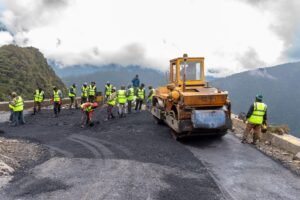
The TU cricket stadium road upgrade in Kirtipur is moving forward, with work planned to upgrade and blacktop the roads around the Tribhuvan University cricket stadium premises. Infrastructure Development Minister Sunil Lamsal shared the update on November 2, 2026, in a post that set out the next steps in the process and the time frame for the road work.
According to the update, the roads around the stadium are to be improved so that spectators can reach the ground more easily and move around the area with less difficulty. The aim is also to make the physical infrastructure around the stadium more orderly and attractive, so that the area reads as a properly arranged public space rather than a collection of uneven and poorly finished approaches.
That focus matters because a stadium is not used in isolation. On event days, large numbers of people arrive and leave in a short period, while service vehicles, officials, teams and support staff also need clear routes in and out. When access roads are rough, narrow or poorly surfaced, arrival becomes slower, parking and drop off points become harder to manage, and movement for people on foot can feel unsafe or confusing. A smoother and better ordered road network helps separate those flows, keeps entrances clearer, and makes it easier for emergency and maintenance vehicles to reach the site when needed.
TU cricket stadium road upgrade: what will change around the stadium
The work described in the update covers the roads around the stadium premises, with upgrading and blacktopping as the core tasks. Upgrading in this context means improving the road structure and surface so that the roads can carry regular traffic more reliably, while blacktopping provides a sealed asphalt surface that is smoother, easier to maintain and more comfortable for vehicles and pedestrians. The update does not set out a road by road list, a total length or a cost figure, and this article does not add those details.
As part of the TU cricket stadium road upgrade, the practical benefit for spectators is straightforward. A finished surface reduces dust in dry weather and mud and surface water in wet weather, and it gives drivers a clearer and more predictable route to the stadium. For the surrounding area, an orderly road layout can also make it easier to keep footpaths, parking areas and service access distinct, which is important when crowds are present and when local residents still need to use nearby streets.
Where the project stands in the tender process
The Road Division under the Ministry of Infrastructure Development has completed the technical evaluation stage. In a public tender process, technical evaluation is the step in which bids are checked against the technical requirements of the work before price is considered. Only after that stage is complete does the process move to the financial stage, in which the price proposals of the technically qualified bidders are opened and compared under the rules of the tender.
The update states that the financial proposals are to be opened on Kartik 19. Once that step is taken, construction work will move forward. The schedule given in the update is completion of the road upgrade and blacktopping work within 90 days. That 90 day period is the time frame stated for the road work itself, rather than a separate date for a single event or opening.
It is important to keep the stages in order. Technical evaluation does not by itself start construction, and opening financial proposals does not by itself finish a road. Each step creates the conditions for the next one: a qualified field, a price comparison, an award under the tender rules, and then mobilisation and construction on site. Readers who follow the project should therefore look for the outcome of the Kartik 19 financial proposal opening as the next public milestone, followed by evidence of work on the ground.
Why access roads are a wider infrastructure issue
Stadium access roads also illustrate a wider point about urban infrastructure in the Kathmandu Valley. Roads that serve a single large venue are also local roads for the neighbourhood around it. When they are in poor condition, the effect is felt on ordinary days as well as on event days, through slower travel, higher vehicle wear and a less attractive streetscape. When they are improved, the benefit is shared by visitors and residents alike, even though the immediate reason for the work is tied to the stadium.
Similar pressures are visible elsewhere in Nepal at present. Recent road reopening work after rain related disruption has underlined how quickly a blocked or damaged road can affect travel, and how important routine maintenance, clearance and resurfacing are to keeping routes open. Readers can follow that wider picture in our report on rain blocked roads reopened in Nepal, and in our update on the B.P. Highway route at Piple and Gimdibesi.
For Kirtipur, the next test will be delivery within the stated schedule. A 90 day completion target is clear and measurable, and it gives residents, spectators and observers a simple way to judge progress: whether work starts promptly after the financial proposals are opened, whether it continues without long gaps, and whether the finished roads match the stated aim of easier access and a more orderly stadium area.
The TU cricket stadium road upgrade should be read as a process update rather than a finished project. The technical stage is done, the financial stage is scheduled, and the construction stage is next. That sequence, if followed on time, would turn a long standing access problem around the stadium into a completed road improvement within three months of the financial proposal opening.
Source: Minister Sunil Lamsal’s Facebook post, November 2, 2026.