
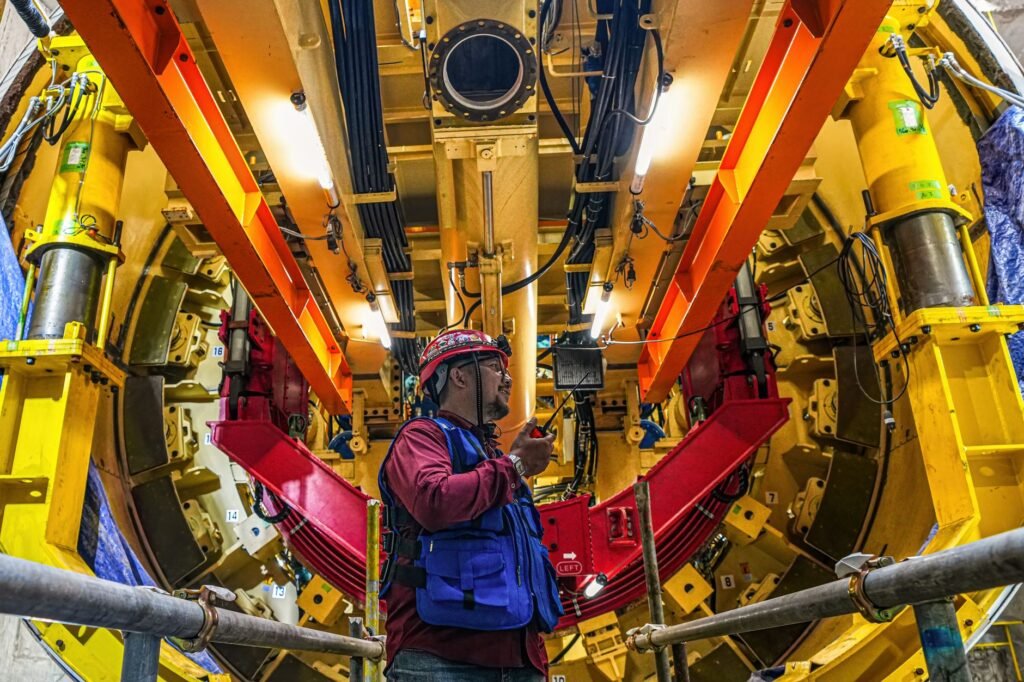
National Grid has completed the Thames cable tunnel breakthrough beneath the River Thames, finishing the 2.2km tunnel drive 49 days ahead of schedule, according to New Civil Engineer. The Herrenknecht mixshield tunnel boring machine, named Caroline, achieved the breakthrough on Sunday 27 September 2026, linking the tunnels between Tilbury in Essex and Gravesend in Kent.
The 400kV cable tunnel is a centrepiece of National Grid’s Grain to Tilbury project, part of its wider Great Grid Upgrade programme. Once energised, the tunnel will replace the ageing 1960s Thames Cable Tunnel and strengthen high voltage electricity transmission between Kent and Essex. The new underground route for high voltage circuits will run between the Isle of Grain and Tilbury, relieving congestion on the existing overhead lines that currently carry power across the region.
National Grid says the early finish was no accident. Careful planning, favourable ground conditions, proven tunnel boring machine performance, and well coordinated logistics all contributed, supported by a dedicated separation plant that processed the excavated material as the machine advanced. The result gives the programme valuable breathing room for the works that follow.
Mixshield machine sets a relentless pace
The engineering behind the drive centred on Caroline, the mixshield TBM supplied with tunnelling specialist services from Herrenknecht. Working beneath the river, the machine installed more than 10,000 concrete tunnel segments, forming almost 1,700 complete lining rings as it advanced. In its most productive month, Caroline drove 926m forward and installed 712 rings. Its peak week saw 229m of progress, and the best single day delivered 41m of advance with 31 rings installed.
How the Thames cable tunnel breakthrough was engineered
The final stage of the drive demanded careful pressure management. Engineers used an intentionally flooded reception shaft to balance pressure between the shaft and the surrounding chalk ground, reducing the risk of groundwater entering the shaft as the machine arrived. The technique allowed the team to complete the reception in a controlled manner. An integrated underwater telescopic camera supported the process, enabling remote inspections of the works and reducing the need for personnel intervention in difficult conditions.
The project was delivered by the Ferrovial BEMO JV as delivery partner, with Mott MacDonald as designer and Herrenknecht providing tunnelling specialist services. National Grid project director Mark Farmer said completing the drive ahead of schedule “is a testament to the expertise, dedication and collaboration of our teams and supply chain partners”, adding that the project “will play a critical role in strengthening the electricity network”. Ferrovial BEMO JV project director Borja Trashorras credited “excellent planning, strong engineering expertise and outstanding collaboration”, while Herrenknecht board member Ulrich Schaffhauser said the fast completion “shows the value of effectively coordinating all project components, technologies, and services.”
Why this Thames cable tunnel breakthrough matters
The tunnel does more than set a tunnelling record. It creates a resilient underground corridor for high voltage circuits between the Isle of Grain and Tilbury, taking pressure off congested overhead lines and reinforcing the electricity network that serves Kent and Essex. Within the Great Grid Upgrade, the project is one of the key links that will carry growing volumes of power as generation patterns shift. The early completion also sets a schedule certainty benchmark: finishing 49 days ahead of plan frees valuable time for the works that follow.
What happens next
With the drive complete, attention turns to the tunnel fit out. Dewatering of the tunnel continues through October, followed by secondary lining works, cable pulling and jointing to bring the 400kV circuits into service. Each stage will prepare the new route for energisation, when the replacement for the 1960s crossing finally takes up its role beneath the Thames.
This report was filed from Kathmandu on October 10, Nepal time, for Global Engineering Daily.
Source: New Civil Engineer: National Grid completes 2.2km tunnel breakthrough 49 days ahead of schedule