
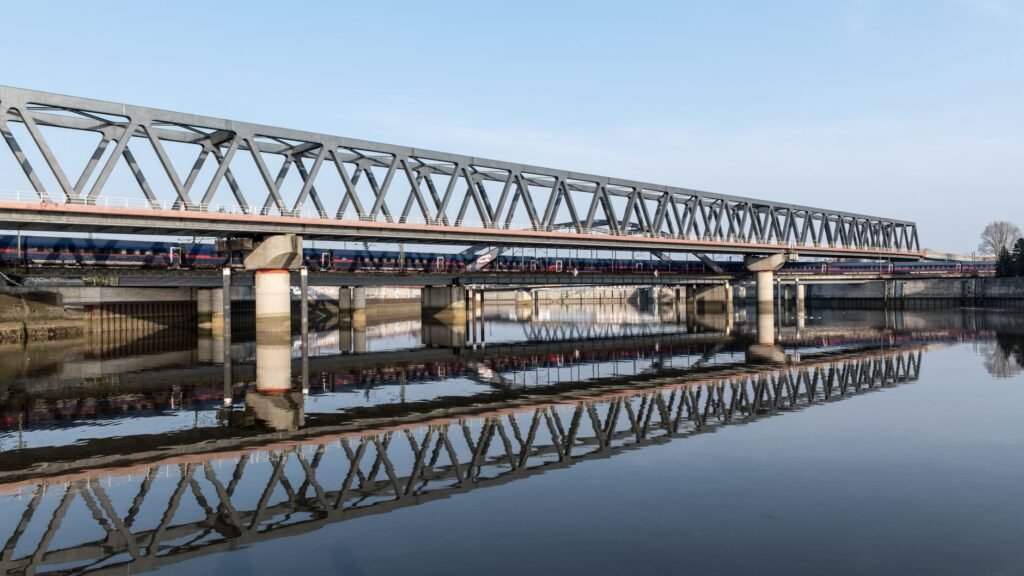
On Friday, October 9, 2026, NJ Transit and Amtrak will transfer the final track off the original Portal Bridge, a 116-year-old swing span over the Hackensack River in New Jersey, and onto the new Portal North Bridge, completing one of the most consequential rail infrastructure projects in the New York metropolitan area. The cutover marks the end of more than a century of movable-bridge operations on one of the busiest rail crossings in the United States.
The first of the two tracks entered service on March 13, 2026, about two and a half days ahead of schedule, after a catenary failure on the old bridge forced an early switch, according to reporting by masstransitmag.com. This week’s final cutover moves the remaining track, after which every train will run on the new structure.
Why the Portal North Bridge Replaces the Swing Span
The new bridge is a modern two-track, high-level fixed span carrying trains 50 feet above the Hackensack River, high enough that it never needs to open for river traffic. Trains will cross at speeds of up to 90 miles per hour, compared with 60 miles per hour on the old structure, according to NJBIZ and 6sqft.com. The century-old swing bridge, built by the Pennsylvania Railroad and opened in 1910, had to rotate open for passing marine traffic and frequently jammed, sometimes in the open position, causing cascading delays across the region.
The Portal North Bridge project is the first phase of the Gateway Program. The new alignment runs about 2.44 miles including its approaches, according to Wikipedia, at a cost of roughly 1.5 to 1.6 billion dollars, though some sources cite 2.3 to 2.4 billion dollars for the wider program scope. Funding includes a 766.5 million dollar grant from the Federal Transit Administration, with additional contributions from New Jersey and Amtrak. The design-build work was delivered by the Skanska and Traylor Bros PNB Joint Venture, according to constructionreviewonline.com.
Ending a Century of Delays on the Northeast Corridor
The bridge sits on the Northeast Corridor between Newark and Secaucus, New Jersey, and is used by both Amtrak and NJ Transit. It carries up to 150,000 to 200,000 passengers a day on about 450 daily trains, making it the busiest rail span in the Western Hemisphere, according to Wikipedia. NJ Transit CEO Kris Kolluri said in a September 17 report: “Five weeks of adjusted schedules will deliver a modern, high-level bridge that ends a century of swing-bridge delays for customers traveling the Northeast Corridor to and from New York.”
What Happens Next
Following the October 9 cutover, adjusted schedules will run from October 11 through November 14 while crews finish the remaining work, according to 6sqft.com. Regular service is expected to resume on November 15. Once the new bridge is fully in service, all rail traffic to and from New York Penn Station will use the Portal North Bridge, and the old swing bridge will be permanently removed from service.
Readers can follow the detailed coverage in the RT&S report on the cutover and the 6sqft.com account of the five-week service plan.